The problem, as reported
Every session of Claude Code starts with a fresh context window. Anthropic's memory docs say so in the first line. Codex is the same. Whatever the last session worked out is not in the next one unless it was written into a file that loads at launch, and the reports about what that costs keep coming.
On the Codex tracker, an open report from 14 September describes a task resumed after a usage limit spending a large part of the new allowance re-reading files, rebuilding what had changed, rerunning checks and working out which steps were finished. On the Claude Code tracker, a feature request with 21 replies asks for what was tried, what failed and why it worked to carry into the next session; today developers keep it by hand in CLAUDE.md or explain it again. And a Show HN with 131 points came from someone who watched Claude Code and Codex debug the same problem twice when the answer was already sitting in months of old sessions on disk.
Rather than describe the difference, here it is. The same question, asked at the start of three sessions. Click the tabs.
Loading…
The project is a worked example (a sign-in bug fixed last month), and everything shown is written into the demo, not read from you. What follows is what each tab is showing you, and why.
Tab one: a fresh session
This is the session where nothing about sign-in is in any file that loads at launch. The August session that found and fixed the bug is saved on disk, as a JSONL transcript under ~/.claude, but a new session doesn't open old transcripts. You can resume one conversation at a time with --continue or --resume, and that is all.
What the AI has to go on
So the first reply is the honest one: it asks you to point it at the auth code and describe when the sign-outs happen. It will find the bug again, from scratch, and it may or may not land on the same fix. The reasoning, and the correction about keeping SAML, come from your memory, not its.
Tab two: CLAUDE.md and a handoff file
This is most people's set-up, and it is a real improvement. Two kinds of file load at the start of every session:
- Instructions you write. Claude Code loads
CLAUDE.md(and can readAGENTS.md) every session; Codex readsAGENTS.mdbefore doing any work. The docs call these context, not enforced configuration, and describe CLAUDE.md as the place you write down what you'd otherwise re-explain. - Notes the tool writes. Claude Code's auto memory is on by default: it loads the first 200 lines or 25KB of its
MEMORY.mdindex, it is machine-local, and it skips anything it can derive from the code, "such as architecture, file paths, or debugging fixes". Codex's memories are off by default, written only after a chat has been idle for a while, and OpenAI's own advice is to treat them as "a helpful recall layer, not as the only source for rules that must always apply".
Add a handoff file, rewritten at each milestone and loaded by a hook (the free fix in our earlier article), and the session starts with a summary.
What the AI has to go on
The reply shows the gap. The AI knows sign-in was reworked in August, so it goes to re-check the refresh flow and work out what was done. It has the conclusion, not how you got there: the rotated-token discovery, the test that passed, the pull request, and the decision to keep SAML all lived in the conversation, and nobody wrote them into a file. A summary holds what someone remembered to put in it.
Tab three: with Axiom Lift
Here the AI does one thing before answering: it asks Axiom. Two things had to be true for that to work.
Something kept the conversation. A small helper on your computer reads the session files Claude Code, Codex and OpenCode already write (the same JSONL transcripts as above, Codex's rollouts, OpenCode's database), read-only, never edited. As you work, requirements, decisions and corrections are picked out automatically, so there is nothing to tag and nothing to write up. Keys and passwords are cut on your computer before anything is sent.
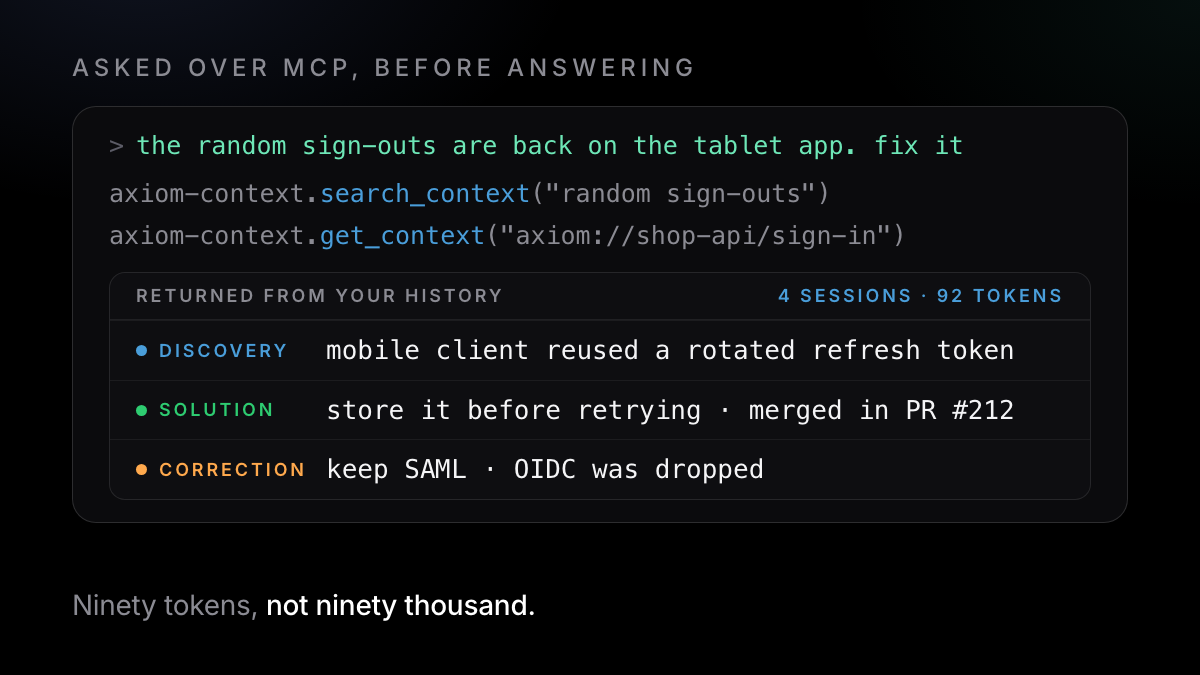
The next session can ask. The installer registers a read-only MCP server with all three tools. When a question touches something in your history, the AI calls search_context and get_context and gets back the few lines that are true now, not the whole conversation.
What the AI has to go on
That is why the third reply starts with "You fixed this in August" and goes straight to the tablet client. It isn't smarter; it was given the answer. Four sessions were searched and 92 tokens came back. Change your mind later and the old decision is struck through, never erased, linked to the moment it was said, so the next session gets the current one and can see what it replaced.
It doesn't replace CLAUDE.md or AGENTS.md for rules that must always apply, and it can't make a model follow anything: what the AI does with what it's given is still up to the AI, and the demo's third reply is one good reply, not a guarantee. It only hands back what was said in a session it captured; if the reason was never said, it isn't there. It covers Claude Code, Codex and OpenCode on a desktop, not Cursor, and not ChatGPT or Claude in a browser. On the free plan your AI can reach the last six months of history.
Files on disk
- Holds what someone wrote. Rules, commands, a summary rewritten at milestones; if it goes stale, nothing warns you.
- Conclusions, not reasons. What was tried, what failed and why stay in the transcript, which a new session never opens.
- One tool, one machine. Claude Code's auto memory is machine-local; Codex's memories are Codex's.
With Axiom
- Captured as you work. Every session from Claude Code, Codex and OpenCode kept, decisions and corrections filed automatically.
- Answered on request. The AI asks over MCP and gets the few lines true now, with a few lines added before each prompt.
- One history for all three tools. What was settled in Claude Code is there when you open Codex or OpenCode.
Install is one command in a desktop terminal (Mac; Linux and Windows in beta; needs Python 3). It brings in the sessions you already have, shows what it found before anything is sent, and axiom uninstall removes it.
One command in the terminal where you use Claude Code, Codex or OpenCode. Free, no card.
Try it free →Claude, Codex and OpenCode are trademarks of their owners; Axiom works alongside them and is not affiliated.